Philip Topham · Savionai

AI will
kill
my company.

Ask ten people in your company about AI and you'll get twenty answers. If that sounds familiar, a conversation is a good place to start.

That disagreement in the room isn't a sign your company is behind. It's a sign the conditions changed faster than the frameworks most leaders are using to navigate them. Two structural dynamics are producing it — and neither one resolves with a better AI vendor or a faster implementation timeline.

Problem 1 — The Rearview Mirror

The playbook your board is using was built for a world AI is actively rewriting.

Every board has a strategic framework — the mental models, risk tolerances, and decision criteria that have guided the company through growth, downturns, and transitions. Those frameworks were built from experience. They worked.

The problem is that AI doesn't just add a new line item to the strategic plan. It changes the conditions under which the plan was built. Market dynamics shift faster. Competitive advantages erode differently. The assumptions about how long you have to make a decision — and what information you'll have when you make it — are no longer reliable.

Most boards recognize this intellectually. Very few have updated their actual decision-making apparatus to account for it. The result is a widening gap between the world the board is governing for and the world the company is operating in.

That gap is where governance risk lives.
Problem 2 — The Speed Trap

AI moves faster than your board's decision-making cycle. The answer isn't "move faster."

The instinct when confronted with AI's pace is to accelerate. Move faster. Decide sooner. Approve more quickly.

This is a trap. Speed without judgment doesn't produce better decisions — it produces faster bad ones. And in a private company, where decisions compound across employees, families, suppliers, and communities, a fast bad decision doesn't self-correct. It compounds.

The real challenge isn't speed. It's developing the organizational capacity to make high-quality decisions at a pace the board has never operated at before — without surrendering the deliberation that makes those decisions trustworthy.

Most boards are not equipped for this. Not because they lack intelligence or commitment, but because the decision-making infrastructure they've relied on was designed for a different tempo.

These aren't problems that resolve with a better AI vendor or a more aggressive implementation timeline. They resolve with a different kind of thinking at the governance level — and most boards don't have access to it.

The people advising your board on AI have a structural conflict of interest.

AI consultants work downstream of the decision you haven't made yet. They implement. They optimize. They select tools. Their revenue depends on you adopting something — and their expertise begins after you've already committed.

Management consultancies work at the right altitude but the wrong specificity. AI-mediated decision-making in private companies is not a strategy question they're staffed to address with the depth it requires.

Governance advisors work the compliance layer. Necessary, but insufficient. Compliance tells you what you're required to do. It says nothing about whether the decisions you're making within those boundaries are sound.

What's missing is an advisor who works upstream of all three — at the point where leadership judgment meets AI's influence on how decisions get formed. Someone whose revenue is structurally independent of what you adopt. Someone who strengthens the board's capacity to govern AI rather than delegating it.

That gap is what SavionAI exists to fill.

SavionAI

Board-level AI advisory. Upstream of implementation. Independent of every vendor.

SavionAI is a leadership judgment advisory firm for private company boards and CEOs. We work in the governance layer — where the quality of decisions determines whether AI compounds advantage or compounds risk.

We don't implement technology. We don't select vendors. We don't carry partnerships, reseller agreements, or preferred-tool relationships. That independence is structural, not aspirational — it means every conversation serves your interest exclusively.

Our work begins where most AI advisory ends: before a tool is selected, before an implementation is scoped, before a vendor is in the room. We help boards and leadership teams develop the judgment infrastructure to govern AI deliberately — so the decisions that follow are theirs, not someone else's.

What changes after working with SavionAI

  • The board develops shared language for AI governance — replacing fragmented individual views with a coherent governance posture.
  • Leadership gains clarity on where AI has already entered the decision landscape and whether adequate oversight exists.
  • The organization builds capacity to make high-quality decisions at the pace AI demands — without sacrificing deliberation.
  • When it's time to engage implementation partners, the board knows what it wants, why it wants it, and what it's unwilling to compromise.

Judgment. Command. Clarity.

The quality of thinking AI should strengthen, not replace. The authority to remain genuinely in charge of where the organization goes. An accurate picture of what AI is and isn't doing to your decision landscape — right now.

"SavionAI strengthens leadership judgment in private companies where AI reshapes decision-making and amplifies consequences."

"We carry no technology agenda. That is structurally impossible for firms that also implement."

Work With Philip
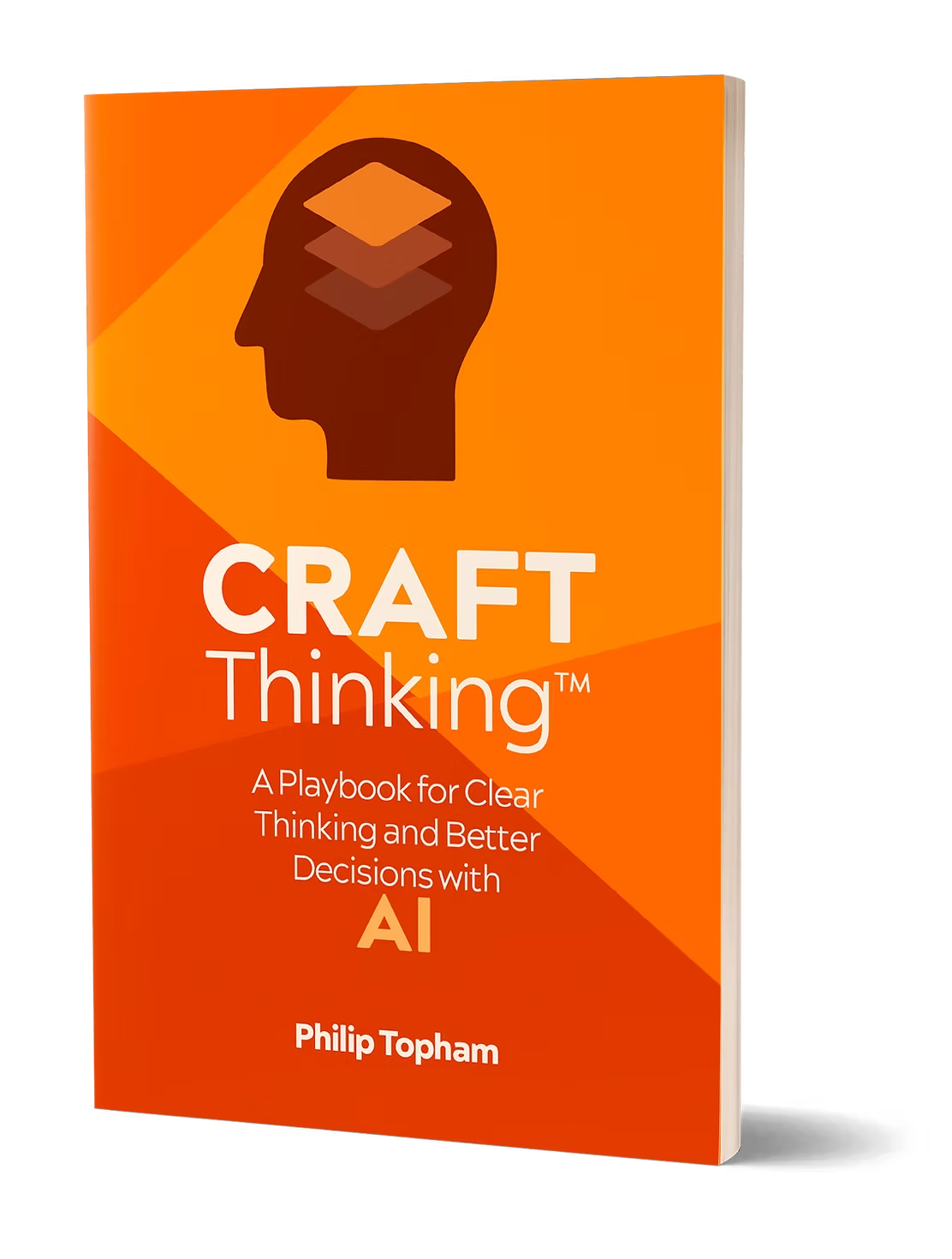
CRAFT Thinking™

The framework behind the advisory. Structured thinking with AI — not through it.

Better Thinking → Better Questions → Better Insights → Decisions You Stand Behind

The two problems your board faces — the rearview mirror and the speed trap — don't resolve with better tools. They resolve with better thinking.

CRAFT Thinking™ is the proprietary methodology beneath SavionAI's advisory work. It provides a structured, layered approach to reasoning with AI that preserves human judgment, accountability, and authorship at every level.

Level 1

Hindsight

Clarity

Getting complete, structured answers to defined questions. AI as research assistant — powerful, but bounded by the quality of the question.

Level 2

Insight

Mirror

Surfacing blind spots, challenging assumptions, reframing problems before they compound. AI as mirror — reflecting your thinking back with enough distance to see what you're missing.

Level 3

Foresight

Simulator

Scenario planning, strategic preparation, navigating genuine uncertainty. AI as simulator — testing decisions against futures you haven't lived yet.

Level 4

Mastery

Action

Operational confidence, consistent execution, AI as co-pilot. The point where structured thinking becomes organizational capability — not just personal skill.

The result isn't faster output. It's decisions your board can stand behind — informed by AI, authored by your leadership.

What readers and board directors say

CRAFT Thinking™ cuts through the hype to focus on what actually matters: better decisions.

Kristen Simmons Board Director, former Fortune 500 C-Suite Executive

The playbook senior leaders and boards have been missing.

Jason Odden Board Chair & Strategic AI/Cloud Executive

This isn't really a book about AI. It's a book about thinking well in a world where AI is now part of the environment.

Cody Avery The Thought Shelf

★★★★★

Amazon #1 Best Seller
Business Systems & Planning · Computer Software

Is this your situation?

You're the CEO or senior executive of a private company, and you can see that AI is reshaping how your organization thinks and decides — but the advisory landscape is full of implementers selling tools, not advisors strengthening judgment.

Or you serve on the board of a privately held company — a closely held firm, a family enterprise, a founder-led organization — and AI has moved from a future topic to a present governance question. You're not sure your board has the shared language, risk framework, or decision-making infrastructure to govern it well.

You understand that the decisions being made now — about AI adoption, governance, and organizational capacity — will compound in ways that are difficult to reverse. You're looking for structured thinking, not trend coverage. Judgment, not shortcuts. An advisor who will tell you what you need to hear, including "not yet" or "not this way."

If that describes your situation, we should talk.

SavionAI is not optimized for entry-level AI adoption, prompt engineering, or tool-first exploration. The work assumes board-level authority and fiduciary consequence.

About Philip Topham

Two decades deploying analytical systems at enterprise scale — before AI was a boardroom conversation.

Philip Topham spent twenty years building and deploying AI-adjacent analytical systems across major global enterprises — including foundational patents in social network analytics and commercial deployments to Merck, Pfizer, Sanofi, and Aventis. He watched analytical systems reshape how organizations think and decide, from the inside. That experience is not assembled from reading.

Today, Philip is the founder of SavionAI and the creator of CRAFT Thinking™. He co-chairs the National AI SIG under the Private Directors Association and serves on PDA's 2026 National AI Task Force — bringing governance depth to the boardroom conversations that matter most.

He writes The Shift. Lift. — a Substack for private-company leaders whose decisions quietly shape markets, communities, and futures. CRAFT Thinking™ is an Amazon #1 Best Seller, endorsed by board directors, CEOs, organizational psychologists, and university innovation leaders.

Select endorsements

"I've seen Philip's framework in action through our work co-chairing the SoCal AI SIG, and it consistently helps executives cut through noise and make grounded, responsible decisions."

Fayeron Morrison, CPA, CFE Founder & President, Elemental AI; AI Governance Strategist

"Philip brings disciplined, structured thinking to the challenge. CRAFT Thinking™ captures that mindset and helps leaders make smarter moves."

Mike Miller Technology Advisor

"Philip translates complex uncertainty into usable frameworks for founders, investors and boards alike."

Scott Brovsky Entrepreneur in Residence, UC Riverside

Resources

The Three Speeds of AI

AI is moving at three decoupled speeds — capability, infrastructure, and adoption — and most leaders are calibrating primarily to the slowest and least predictive of the three. The articles below, published in The Shift. Lift., unpack each speed in depth and what deliberate calibration looks like for private company leaders and their boards.

The Series  ·  The Shift. Lift. on Substack

  1. You're Not Behind. You're Miscalibrated. The same AI data. Three completely different conclusions. All aimed at the wrong layer.
  2. The Two Years You Can't Buy Back Every company has access to the same AI tools today. Not every company has the same two years of learning.
  3. It Doesn't Matter If It's a Bubble. The question isn't whether the valuations hold. It's what gets built regardless.
  4. Everybody's Right. That's the Problem. When everyone is experiencing AI differently, the adoption data confirms whatever you already believe.
  5. AI: Now What? Your first answer says...

Article links will be updated as each piece is published.

Self-Assessment

Which layer are you leading from?

Six questions designed to surface which of the three speeds you're naturally navigating from. Not to judge where you are — to make it visible. Knowing your anchor is the precondition for choosing deliberately.

Take the Assessment →

Where would you like to start?

Board Advisory

Work directly with Philip on AI governance.

Board orientation, governance frameworks, and leadership judgment at the governance level. Begins with a scoped conversation to determine fit.

Book a Conversation

CRAFT Thinking™ Book

The practical framework — board-level application.

Executive use and team adoption. Available in paperback and Kindle. Amazon #1 Best Seller in Business Systems & Planning.

Get the Book

Speaking

Philip at your conference or board event.

Structured thinking on AI governance and leadership judgment. Board conferences, executive summits, and PDA chapter events nationally.